
Understanding Expected Value and House Edge in Blackjack: A Clear, Math-Backed Guide
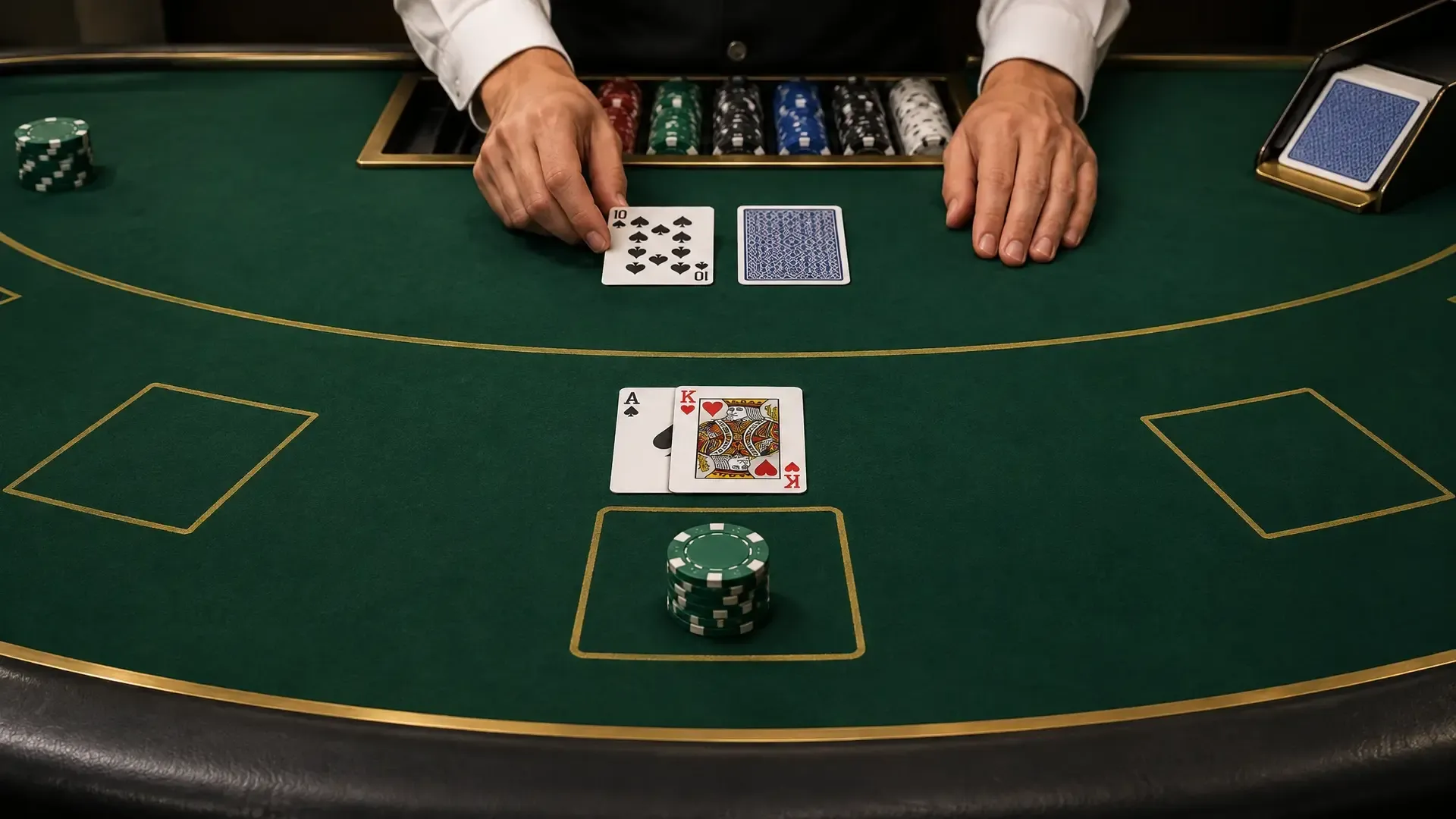
Blackjack expected value and house edge describe the long-run mathematics of the game. They do not predict what will happen on the next hand, and they do not guarantee that a short session will finish with a loss or a win. Instead, they provide a framework for comparing possible outcomes over a very large number of similar wagers.
Expected value and house edge in plain English
Expected value (EV) is the probability-weighted average result of a wager or decision. In other words, it asks: if the same situation were repeated many times under the same conditions, what would the average net result be each time?
A positive EV means the average result is a profit. A negative EV means the average result is a loss. An EV of zero means the outcomes balance on average before considering any other costs. This is an average across repetitions, not a forecast for one hand.
House edge is the casino's long-run advantage, normally expressed as a percentage of the amount wagered. In this article, the player's EV is measured as net profit per initial unit wagered. With that sign convention, house edge is the negative of player EV when both use the same unit and assumptions:
House edge = − player EV per unit wagered
Thus, a player EV of −0.01 units per initial unit wagered corresponds to a 1% house edge under the stated rules and strategy. That percentage is not a universal property of every blackjack table. It depends on the rules, the player's choices, and exactly what is included in the calculation.
The basic EV formula
The general formula is:
EV = ∑ (probability of outcome × net payoff of outcome)
“Net payoff” is important. If you wager one unit and win an even-money hand, the net profit is +1 unit, not the total 2 units returned. A loss has a net payoff of −1 unit. A push returns the stake but produces a net payoff of 0.
For a simple model with only wins, losses, and pushes, the formula becomes:
EV = (Pwin × net win) + (Ploss × net loss) + (Ppush × net push)
A worked illustrative example
Suppose an intentionally simplified model assumes the following outcomes for one unit wagered:
- Win probability: 0.42, with a net payoff of +1 unit
- Loss probability: 0.48, with a net payoff of −1 unit
- Push probability: 0.10, with a net payoff of 0 units
The probabilities add to 1.00, so they account for every outcome in this simplified example. Substituting them into the formula gives:
EV = (0.42 × +1) + (0.48 × −1) + (0.10 × 0) EV = 0.42 − 0.48 + 0 EV = −0.06 units per wager
The expected profit is therefore a loss of 0.06 units per initial wager, or 6% in this illustrative model. The corresponding house edge is 6%. This does not say that every 100 hands will produce exactly a six-unit loss, nor does it claim that these probabilities describe a particular blackjack ruleset. It simply demonstrates how the arithmetic works.
The expected loss is also not the same as the total amount wagered or returned. If a player makes 100 initial one-unit wagers, the model's expected net result would be −6 units. The total money returned would depend on wins, pushes, doubles, splits, and the sequence of actual outcomes.
How a realistic blackjack EV model differs
Actual blackjack has more than three outcome categories. A natural blackjack may receive a special payout, while a doubled hand has a larger stake and a split can create additional hands. A more complete model assigns each possible final outcome a probability and a net payoff:
EV = (Pregular win × payoff) + (Pblackjack × blackjack payoff) + (Ploss × −stake) + (Ppush × 0) + other applicable outcomes
For a calculation to be meaningful, the assumptions must be stated. They include the blackjack payout, whether the dealer stands or hits on a soft total, doubling and splitting rules, surrender availability, the number of decks, and the dealer's hole-card procedure where relevant. Even a small rule change can alter the probabilities of reaching different outcomes or the amount paid for them.
The unit of measurement must also be clear. EV can be reported per initial hand, per unit initially wagered, or per total amount placed into action. These are not automatically interchangeable. A player who doubles or splits may risk more than the original unit, so a calculator should explain whether its denominator is the first wager or all wagers made during the hand.
Why player decisions change the result
Blackjack is not a fixed-odds wager in which the player simply accepts one predetermined probability. The player chooses actions such as hit, stand, double, split, or surrender when those options are available. Each decision changes the distribution of later outcomes and therefore changes EV.
This is why a published blackjack house-edge figure usually assumes a specified playing strategy. An edge calculated for mathematically strong decisions is not automatically the edge experienced by every player. A mistake may have little effect in one situation and a larger effect in another. For readers learning how decisions are evaluated, blackjack basic strategy provides useful context, but a strategy guide and an EV calculation answer different questions.
Strategy also needs to be separated from betting progressions. Increasing or decreasing the stake does not change the underlying expectation of a negative-EV hand. It changes the size and timing of possible results, not the mathematical advantage built into the rules.
Do side bets belong in the main house-edge figure?
Usually, no. A main blackjack house-edge calculation should identify the base-game wager being analysed. Side bets have their own outcome tables, payouts, probabilities, and often a different mathematical expectation. Combining them with the base game can make a headline number difficult to interpret unless the calculation clearly states the mix of wagers.
Anyone comparing a table's figures should therefore check whether side bets are excluded and review blackjack side bets separately. A side bet's presence does not change the definition of EV for the base wager, but choosing it creates an additional wager with its own EV.
Variants, rules, and headline percentages
“The house edge in blackjack” is incomplete as a statement unless it identifies the game and assumptions. Different versions can change the available actions, payout structure, deck composition, or dealer procedures. Those differences can affect both the probability of each outcome and its payoff. When comparing blackjack variants, look for the exact rules behind any quoted percentage.
Headline figures may also omit table limits, commissions, promotional terms, unusual payouts, or the player's actual decision quality. A number presented without its ruleset and strategy assumptions should be treated as a conditional estimate, not a universal fact. The same caution applies to calculators: check their definitions, denominator, treatment of pushes, and handling of doubles and splits.
What negative EV means over a short session
Negative EV describes the average direction over many repetitions. It does not mean every short session must lose. Random variation, often called variance, can produce a win or a loss even when the long-run expectation is negative. A natural blackjack, a sequence of doubles, or several unusual outcomes can make a short sample look very different from its expected result.
As the number of comparable hands increases, the average result may move closer to the mathematical expectation, but no fixed session length guarantees that it will do so. Expectation is a benchmark for repeated play, not a promise about an individual hand or a particular visit.
Blackjack EV and house edge: the practical takeaway
To evaluate any claimed blackjack edge, ask four questions: What outcomes are included? What are the probabilities and net payoffs? Which rules apply? What playing strategy and denominator were used? The core calculation is always probability multiplied by net payoff, added across all possible outcomes.
Expected value tells you the average net result per defined wager under stated conditions. House edge expresses the same disadvantage from the house's perspective when the player's EV is negative. Neither predicts the next hand, and neither turns a negative expectation into a guaranteed result. A careful, transparent calculation is therefore more useful than a bare percentage detached from the rules that produced it.
(DeBlackjack Editorial Team)