
How to Use a Blackjack Basic Strategy Chart: A Beginner’s Guide to Rules and Deck Variations
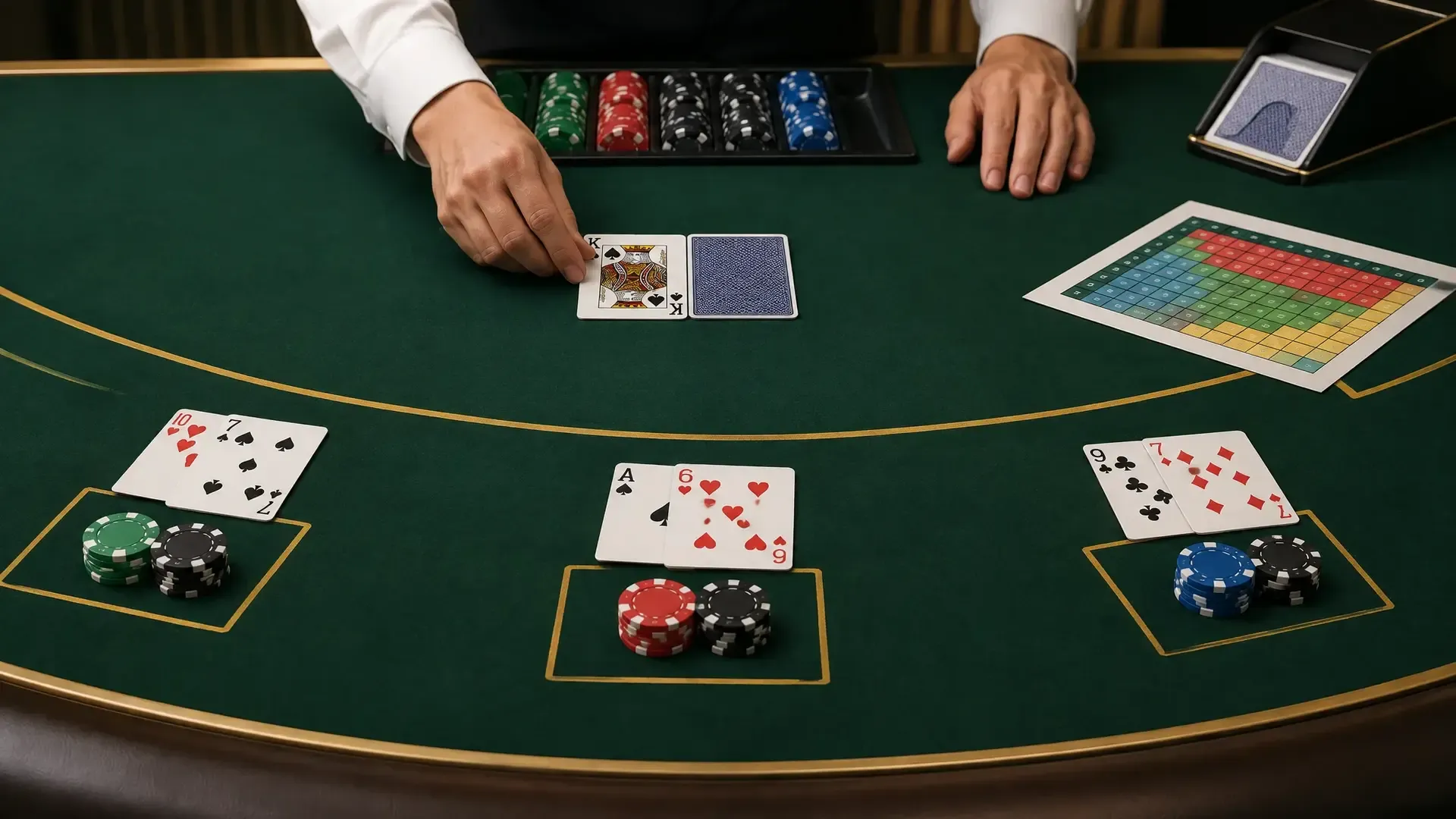
A blackjack basic strategy chart is a lookup tool, not a prediction system. You identify your hand, identify the dealer’s visible card, and follow the recommended action for the exact number of decks and table rules. It does not tell you which card will come next or guarantee a win. Instead, it shows the mathematically strongest playing decision over many comparable hands.
Before using any chart, it helps to understand the game’s vocabulary and sequence in a guide to how to play blackjack. Once those foundations are clear, a chart becomes much easier to use at a physical table or online.
What a basic strategy chart shows
Most charts compare two things: your hand category or total and the dealer’s upcard. Your hand appears down the left side, while the dealer’s cards appear across the top. The dealer’s upcard is the one visible card; the hidden card is not used when you make your decision.
The dealer columns commonly run from 2 through 10, followed by A for ace. Some charts label the 10 column “10,” while others use “10-value” to include a ten, jack, queen or king. These cards have the same numerical value for the purpose of the initial decision. Always check the chart’s key before reading a cell.
A cell contains an action such as H, S, D, Dh, P or Su:
Colours and symbols vary. A chart might use one colour for hitting and another for standing, or add notes for exceptions. Never rely on colour alone if the legend is missing. An unexplained screenshot may have been designed for a different ruleset.
Classify your hand correctly
Before looking across the chart, decide whether you have a hard hand, soft hand or pair. This is more important than simply adding the cards, because the same apparent total can lead to different recommendations.
A hard hand either contains no ace or contains an ace that must count as 1 to avoid going over 21. For example, 10 and 6 is hard 16. A hand of ace, 6 and 10 is also hard 17, because counting the ace as 11 would bust the hand.
A soft hand contains an ace that can count as 11 without busting. Ace and 6 is soft 17, not hard 17. If you draw a card that makes counting the ace as 11 impossible, the hand becomes hard. Soft hands are often treated differently because an additional card can change the ace’s value.
A pair consists of two cards of the same rank, such as 8-8 or ace-ace. Look at the pair section before treating the cards as an ordinary total. Splitting changes one hand into two, so pair decisions are not simply hit-or-stand decisions.
How to use the chart step by step
15. Check the rules first. Note the number of decks and important conditions, including whether the dealer hits or stands on soft 17, the blackjack payout, doubling restrictions, late surrender and whether doubling after splitting is allowed.
16. Identify the hand type. Start with the pair section if you have a pair. Otherwise choose the hard-total or soft-total section.
17. Find the dealer’s upcard. Use the ace column for an ace and the 10-value column for any ten-value card, according to the chart’s labels.
18. Read the intersecting cell. Follow the action and any note attached to it. If the cell says double only when permitted, use its fallback instruction when the table does not allow doubling.
19. Act before second-guessing the result. The chart is based on the information available before the next card is dealt, not on what happened in the previous hand.
At a live or physical table, check the felt or posted rules before placing a wager, then compare your cards with the dealer’s upcard. At an online table, read the rules panel and make sure you understand which button means hit, stand, double or split. Prompts and auto-play settings can be useful interface features, but they are not substitutes for checking that the selected chart matches the game.
When to hit, stand, double or split
Hit and stand decisions depend on both your total and the dealer’s upcard. A high hard total may be strong enough to stand against some dealer cards but vulnerable against others. A low total will often need a hit, while a soft hand may be able to take a card without the same immediate bust risk. There is no single rule such as “always stand on 17” that covers every hand category and chart variation.
Doubling is a conditional opportunity, not a betting system. The chart may recommend doubling when one additional card has a favourable mathematical relationship to your hand and the dealer’s exposed card. If doubling is unavailable, follow the chart’s fallback, commonly a hit, rather than placing a larger wager later to compensate.
Splitting is also conditional. A pair may be worth separating in one situation and playing together in another. After a split, special rules may apply: the table could restrict doubling, limit resplitting or handle two aces differently. Those conditions must be reflected in the chart you use.
Surrender is available only at some tables. If the chart recommends it but the table does not offer it, use the chart’s stated alternative. Do not assume that a generic “best” replacement is valid under every set of rules.
Why decks and rules matter
Single-deck and multi-deck games do not always have identical basic strategy charts. The composition of the remaining cards and the probability of particular outcomes change with the number of decks. A single-deck chart should therefore not be treated as interchangeable with a multi-deck chart.
Deck count alone is not enough. Dealer hits or stands on soft 17, blackjack payout, whether doubling is restricted, whether late surrender is offered and whether doubling after splitting is allowed can all affect recommendations or the game’s mathematical return. Select a chart that states its assumptions clearly. If the game rules do not match, look for a rule-specific chart or calculator rather than guessing from a familiar image.
For an illustration, suppose a chart is explicitly labelled for a particular multi-deck game, a specified soft-17 rule, late surrender and the table’s doubling conditions. You might find that the cell for a hard total against a particular dealer card says “Dh,” while a nearby soft total says “D.” That demonstrates the lookup method: classify the hand first, then follow the matching cell. It does not establish a universal decision for every blackjack table. Use the complete chart made for your actual rules.
Expected value and common mistakes
Basic strategy is about expected value: over a large number of similar hands, it selects the action that is mathematically strongest among the available choices. Individual results still vary. You can make the correct decision and lose, or make a poor decision and win. Basic strategy cannot predict the next card, remove variance or guarantee profit, and it does not turn a negative-expectation game into a risk-free activity.
Beginners commonly confuse soft and hard hands, overlook the pair section, use a single-deck chart at a multi-deck table or ignore rule notes. Others change decisions because the previous hands produced several high or low cards, treating basic strategy as a prediction or betting system. A useful review of common blackjack mistakes can help reinforce the difference between a playing decision and a wagering belief.
Play responsibly
Blackjack is for adults aged 18 and over. Set a budget and a time limit before playing, treat the money as entertainment spending, and never chase losses or gamble under the influence of alcohol or other substances. A chart can improve decision quality, but it cannot make gambling harmless or guarantee a result.
If gambling stops feeling recreational, becomes difficult to control or interferes with money, work or relationships, stop and seek specialist support available in your jurisdiction. Responsible play means being willing not to gamble at all when the activity no longer fits within your limits.
With the right chart in hand, the process is straightforward: verify the rules, classify the hand, locate the dealer’s upcard, read the correct cell and accept that short-term outcomes remain uncertain. That disciplined routine is the purpose of learning blackjack basic strategy rather than relying on guesses or previous results.
(DeBlackjack Editorial Team)