Blackjack Variants Compared: Rules, Key Differences and How They Affect Strategy
Blackjack is not one universal rule set. Two tables may look almost identical while offering different dealer procedures, payouts, restrictions and odds. Those details can change the best decision for a hand and the mathematical advantage held by the house.
This guide explains the main blackjack variants in plain English, using conventional blackjack as the baseline. It then compares European blackjack, American blackjack, Spanish 21 and Pontoon, with particular attention to the rules that matter before you assess a table. For a broader introduction to the subject, you can also read about blackjack variants.
The conventional blackjack baseline
In standard blackjack, each player tries to finish closer to 21 than the dealer without going over. Number cards count at face value, picture cards count as 10, and an ace can count as either 1 or 11. A two-card hand containing an ace and a 10-value card is a natural blackjack, which is normally treated differently from an ordinary 21 made with three or more cards.
The player may usually stand, take another card (hit), double the original wager and take one additional card, or split a matching pair into two hands. Some tables also offer surrender, allowing a player to give up the hand and recover part of the wager. The dealer follows fixed instructions rather than choosing freely, typically hitting or standing according to the total and the table's soft-17 rule. A soft hand contains an ace being counted as 11, so “dealer hits soft 17” and “dealer stands on soft 17” are materially different rules.
Conventional blackjack commonly uses a 3:2 payout for a natural, but the published table rules must be checked rather than assumed. A reduced natural payout can have a significant effect on the game, even if the rest of the layout appears familiar.
European versus American blackjack
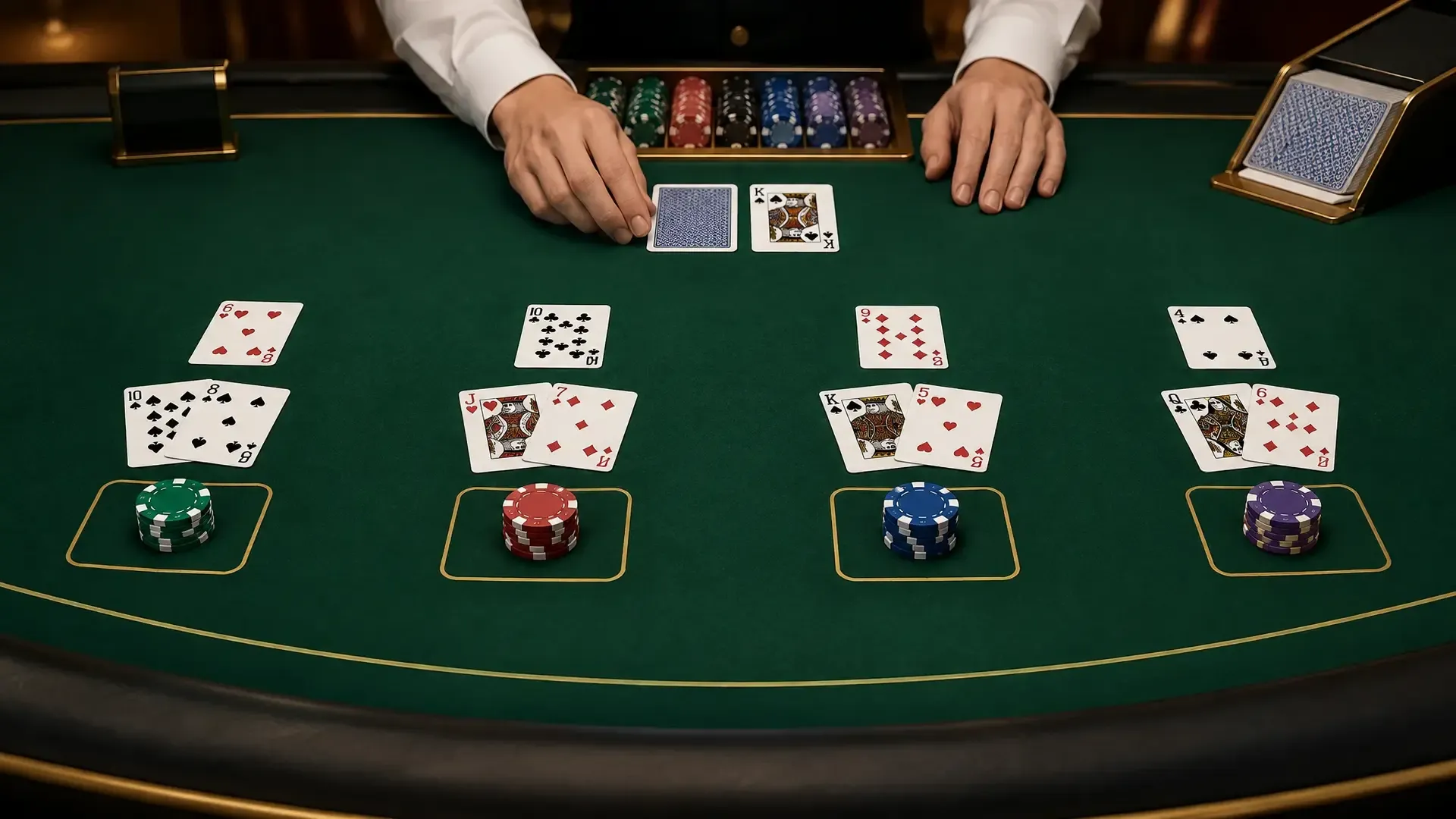
The most important difference is often the dealer's hole-card procedure. In the common American version, the dealer receives a face-up card and a face-down card at the start. The hidden card is checked under specified conditions for a dealer blackjack before players continue, which can prevent players from making extra decisions against a hand that has already won.
In the common European version, the dealer may initially receive only one visible card and take the second card after the players have acted. This is often called the no-hole-card procedure. If the dealer then makes blackjack, a player may lose not only the original wager but also additional money committed through doubling or splitting, depending on the exact rules. That possibility changes the value of aggressive plays and is one reason a strategy chart for American blackjack should not automatically be used for European blackjack.
Regional labels are not enough to settle every question. European tables can differ over when doubling is allowed, whether hands may be split again, and whether surrender is available. American tables can also vary, so the complete rules are more useful than the name printed above the table.
Spanish 21: removed tens and player-friendly bonuses
Spanish 21 is based on blackjack but usually removes the 10-value cards from the shoe while retaining the other cards with their normal values. Picture cards remain 10-value cards, so this is not the same as removing every card worth 10. Removing the ordinary tens changes the composition of the shoe and therefore changes both strategy and the underlying odds.
The variant is also known for player-favourable payments or bonuses for particular 21 combinations. Depending on the version, bonuses may relate to the number of cards in a 21, a special pattern, or a 21 made in a particular way. Spanish 21 commonly gives players additional flexibility in areas such as doubling, surrender or continuing after a double, but those features are not identical at every table.
That combination does not mean Spanish 21 is automatically better for the player. Removing tens, awarding bonuses and imposing other restrictions all interact. The dealer's soft-17 rule, natural treatment, number of decks and permitted actions still matter. Read the specific paytable and rules because games using the Spanish 21 name can differ by jurisdiction or provider.
Pontoon: a related game with its own language
Pontoon is often grouped with blackjack because the aim is similar, but it should not be treated as standard blackjack with a different name. Variant-specific terminology is common: taking another card may be called “twisting”, while standing can be called “sticking”. A two-card 21 is generally known as a Pontoon, and a five-card hand that does not exceed 21 is often given special status as a five-card trick.
The dealer procedure also differs from many conventional blackjack games. In common Pontoon formats, the dealer's cards are concealed until the players have completed their hands, although the exact dealing and settlement rules must be confirmed. Doubling and splitting may be restricted or permitted only under particular conditions, and the treatment of a five-card hand, a Pontoon and a dealer total can vary by operator and jurisdiction.
These differences affect decisions as well as terminology. A move that is sensible in ordinary blackjack may not be correct when a five-card hand has a special value or when the dealer's information is handled differently. A Pontoon-specific strategy should therefore be based on the published rules, not on a standard blackjack chart with terms substituted.
Which rules change the house edge?
There is no single house-edge percentage for “blackjack” or for every version of a named variant. The result depends on the complete ruleset and on how accurately the player follows the strategy suited to it. Important variables include the number of decks, the natural-blackjack payout, whether the dealer hits or stands on soft 17, and whether the dealer checks for blackjack before players can increase their wagers.
Doubling restrictions, splitting rules, re-splitting, surrender, the number of cards allowed after a split, and whether a player can double on particular totals all affect expected value. So do special bonuses and side bets. A side bet is a separate wager and should not be folded into the base game's house edge; its own paytable and probabilities need separate analysis. Learn more in this guide to blackjack side bets.
Natural payouts deserve particular attention. A 3:2 payout is not interchangeable with an even-money or reduced payout, and a table that advertises a familiar game name may still use a less favourable payment. Similarly, a soft-17 instruction can shift the dealer's results even though it changes no visible card value.
How to compare a table before playing
Start with the natural payout and dealer procedure. Confirm whether the dealer receives a hole card immediately, whether a dealer blackjack is checked before player actions, and what happens to doubled or split wagers if blackjack is later revealed. Next, check the soft-17 rule, number of decks, doubling conditions, splitting and re-splitting limits, and surrender availability.
For Spanish 21, also check which cards are removed and the full list of 21 bonuses. For Pontoon, confirm the meanings and payouts of Pontoon and the five-card hand, along with the dealer's procedure and restrictions on doubling or splitting. Do not assume that a rule from one table applies to every game carrying the same name.
Finally, use a mathematically verified calculator or strategy chart that matches the entire published ruleset. A general blackjack basic strategy guide can explain the principles, but it cannot account for every combination of dealer procedure, bonuses and restrictions.
Blackjack variant comparison: the practical conclusion
The best way to compare variants is to compare rules, not labels. Treat conventional blackjack as a starting point, then identify the natural payout, hole-card procedure, soft-17 instruction, deck count and player options. For Spanish 21 and Pontoon, add the special bonuses, terminology and variant-specific hand rules to that review.
Once those details are known, assess the complete ruleset with an appropriate strategy source or calculator. This approach avoids assuming that European blackjack, American blackjack, Spanish 21 or Pontoon always has one fixed house edge, and helps you understand how each rule changes the decisions you make.
(DeBlackjack Editorial Team)