Blackjack Side Bets Explained: Payouts, Expected Value and Why They Hurt Your Odds
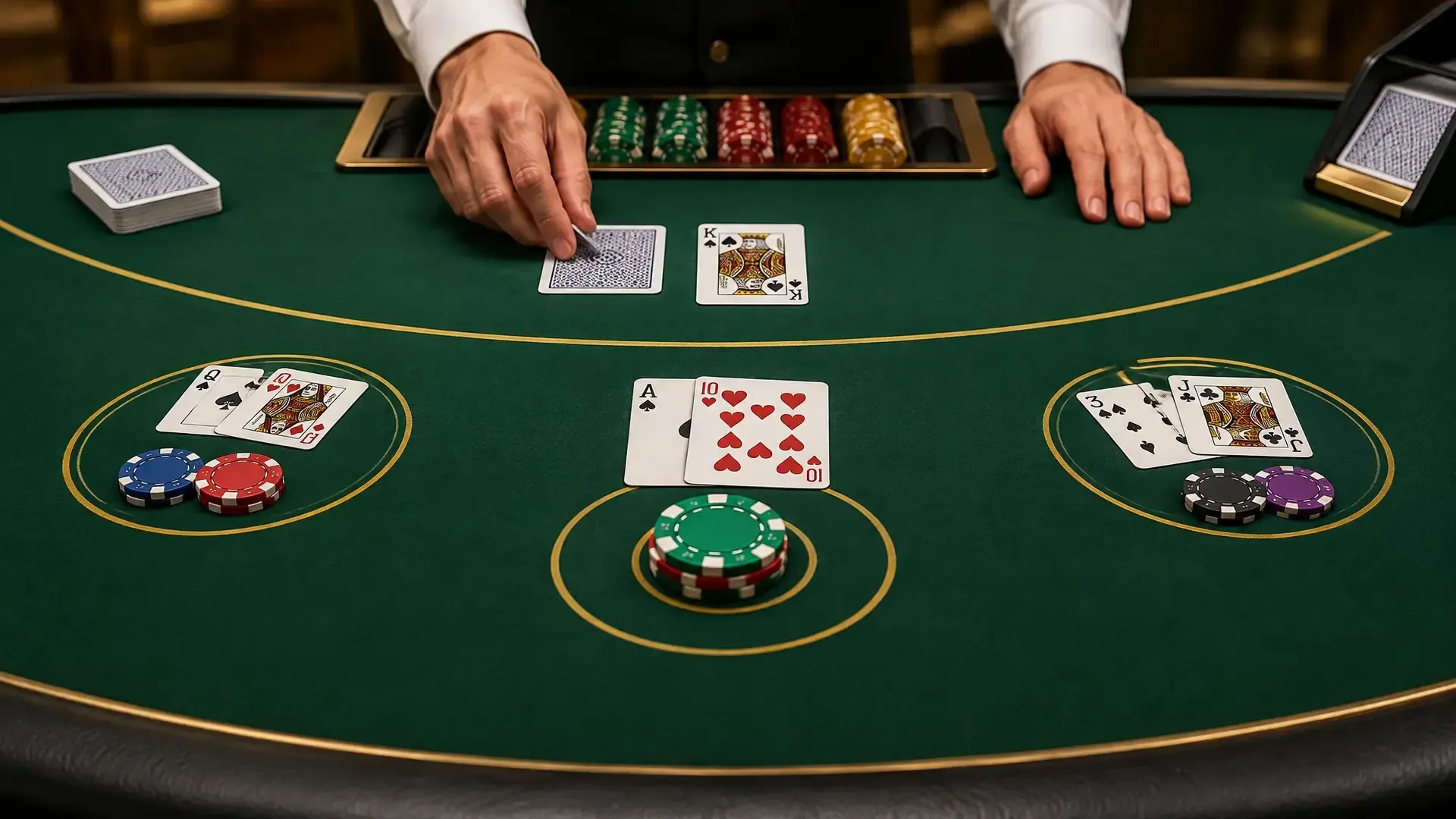
Blackjack side bets are separate wagers placed alongside the main blackjack hand. They do not change the cards dealt for the underlying game or improve the value of your main blackjack bet. Instead, they pay when a specific event occurs, such as a pair in your opening cards, a poker-style combination, or a qualifying dealer hand.
The appeal is easy to understand: a small wager can produce a much larger payout than a standard blackjack win. The important question, however, is how often that winning event occurs and what happens on all the other hands. Rules, qualifying combinations, payout tables and house edges vary by casino, table and game version, so no single description applies everywhere. For a broader overview, see our guide to blackjack side bets.
How side bets differ from the main blackjack wager
Your main blackjack wager is settled according to the result of the hand: a player win, a dealer win, a push, a blackjack or, in some games, a surrender or other rule-based outcome. A side bet is settled separately according to its own conditions. You can lose the side bet while winning the blackjack hand, or win the side bet while losing the main wager.
This separation matters when comparing value. A well-played main blackjack hand and a side bet are not the same mathematical proposition. Basic strategy can help you make better decisions in the main game, but it does not automatically make a side bet profitable. Rules such as the number of decks, dealer procedure and blackjack payout affect the main game, while the side bet’s paytable and qualifying events determine its own mathematics.
Expected value and house edge in simple terms
Expected value, usually called EV, is the average result of a wager over a very large number of repetitions under stated assumptions. To calculate it, multiply each possible outcome’s probability by its net win or loss, then add those results together. A losing one-unit wager contributes minus one unit; a winning wager contributes its net profit, not the returned stake.
For example, imagine a purely hypothetical side bet with this simplified distribution:
- There is a 0.4% chance of a net win of 100 units, a 4% chance of a net win of 10 units, and a 95.6% chance of losing 1 unit.
- The EV is (0.004 × 100) + (0.04 × 10) + (0.956 × -1) = -0.156 units per 1-unit wager.
That produces an expected loss of 15.6% of the wager under those assumptions. The example is not a universal casino paytable; it simply shows how a large advertised payout can coexist with a negative EV. The rare high payout does not outweigh the frequent losing outcomes.
The house edge is the player’s expected loss expressed as a percentage of the amount wagered, under a defined ruleset and paytable. A 5% house edge, for example, would describe an expected loss of 5 units per 100 units wagered over the long run—not a prediction that every player loses exactly 5% in a short session. Short-term results can vary widely, particularly when a bet has rare but large payouts.
Insurance in blackjack
Insurance is offered in some blackjack games when the dealer’s upcard is an ace. It is a separate wager that the dealer’s hidden card will complete a dealer blackjack. If that qualifying event occurs, the insurance bet pays according to the table’s stated terms; if it does not, the insurance wager loses. The main hand is still settled separately.
Insurance is therefore not general protection against every losing hand. It covers one specific possibility: the dealer having blackjack. Whether it has positive or negative value depends on the probability of the dealer’s hidden card being the required rank, the number and composition of the remaining cards, and the insurance payout and rules. Those assumptions can change between games.
A player should not judge insurance solely by its name or by the fact that it can offset a loss on the main hand. The relevant comparison is the value of the insurance wager by itself. Players studying the main game should also keep the distinction clear between this separate proposition and decisions governed by blackjack basic strategy.
Perfect Pairs: matching cards with different payouts
Perfect Pairs usually concerns the player’s first two cards. The bet wins when those cards form a pair, but the qualifying categories may be separated by matching characteristics. Depending on the version, a pair of the same rank and suit may receive a higher payout than a pair of the same rank in different suits, while two cards of the same rank but different colours may form another tier.
The exact labels and payouts are not universal. One table may distinguish suited, coloured and mixed pairs; another may use a different schedule or omit a category. A higher tier also normally corresponds to a less frequent event. To assess the bet, you need the probability of each type of pair and the net payout assigned to it, as well as the probability of missing every category.
This is why a headline payout for a perfect pair does not tell you the bet’s overall value. A calculation based on one paytable cannot automatically be transferred to another table, even if both bets use the same name.
21+3 and poker-style combinations
The 21+3 side bet combines the player’s first two cards with the dealer’s upcard. It pays when those three cards form a qualifying poker-style combination, such as a flush, three of a kind or straight, depending on the version. Some versions also recognise a straight flush or other named combination.
As with Perfect Pairs, the payout tiers and qualifying combinations must be read from the live paytable. The dealer’s upcard is part of the three-card result, so this is not simply a wager on the player’s two-card hand. A calculation also needs to account for the specified deck composition and any game rules that affect the available cards. Without those details, quoting one exact 21+3 house edge would be misleading.
Why side bets often have worse odds
The main blackjack game gives the player decisions that can reduce mistakes, such as whether to hit, stand, split or double under the applicable rules. A side bet usually offers no comparable decision after the cards are dealt: it either matches a narrow event or it does not. Its paytable is designed around that event distribution, and the margin between fair value and the posted payouts is often larger than the margin on the underlying game.
Side bets can also have greater variance. Most wagers may lose, interrupted by an occasional substantial win. That pattern can feel attractive because the winning result is memorable, but it does not by itself indicate favourable value. A side bet with a high possible payout can still have a higher house edge than the main blackjack wager.
Exact comparisons require a defined ruleset. The number of decks, card removal, dealer rules, blackjack payout, side-bet conditions and whether a displayed payout includes the returned stake can all matter. If a table advertises a “10-to-1” win, check whether that means 10 units of profit plus the original stake, or 10 units returned in total.
How to compare a side bet before placing it
Use the paytable as the starting point, not the largest number printed on it. Then check whether a mathematical analysis or house-edge figure is available for that exact version. Compare different versions carefully, because identical names can conceal different qualifying events and payout schedules. A compact review should ask:
- What event qualifies, and how often is it expected to occur under the stated game conditions?
- What is the net payout for every winning category, and what happens when no category is hit?
- What is the calculated EV or house edge for this particular paytable?
- Does the extra wager fit your budget and tolerance for frequent losses and occasional large swings?
It is also useful to compare the side bet with the underlying game rather than treating it as an upgrade to it. Different forms of blackjack can change the main game’s rules and available side bets, so readers comparing tables should first understand the relevant blackjack variants and then inspect each table’s own conditions.
Final perspective
Blackjack side bets are optional, separate wagers built around specific card combinations or dealer events. Their value comes from the full probability distribution, not from the biggest possible payout. Before making a decision, identify the qualifying event, read the complete paytable, distinguish gross returns from net profits, check the probability or house-edge analysis, and consider whether the risk suits you. Treat gambling as entertainment, set limits in advance, and stop if it is no longer remaining within those limits.
(DeBlackjack Editorial Team)